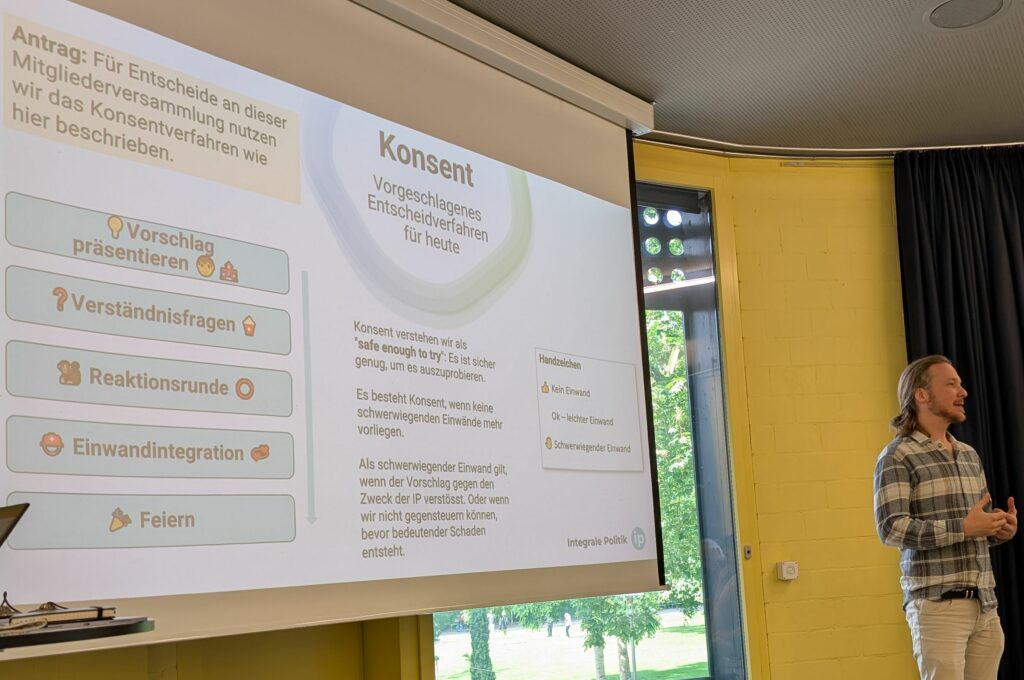
On February 4, 2026, PI Geneva organized a public evening event on the theme of the personal and professional skills required of members of the executive branch. This article summarizes our observations and the ideas we developed from them.
The executive branch of the Swiss government, the Federal Council, operates on a collegial basis. Its members are elected by the Federal Assembly and aim to represent, as best as possible, the diversity of Switzerland as well as the country’s political forces (the so-called “magic formula”). This structure means that there is no opposition. The principle of collegiality encourages Federal Councillors to step beyond the strict lines of the parties of which they are members.
To a large extent, this way of functioning is also found at the cantonal and municipal levels, in terms of collegial governance.
Even though breaches of collegiality sometimes occur, this unique structure nevertheless brings calm and openness to Swiss politics. It is a great privilege of our democracy.
However, this system also leads to a certain slowness. Moreover, the selection process rarely places the right person in the right place. The choice of departments is based on seniority and personal interest, without considering a person’s skills. In a world marked by increasing complexity and an accelerating pace of change, the system is showing its limits. This creates isolation and exhaustion among elected officials, who often find themselves under increasingly harsh criticism.
It is evident that people bearing such responsibilities need support beyond what administrative departments can provide. This support should have multiple dimensions, including personal aspects and the acquisition of necessary knowledge on specific topics. Such tailored support would be particularly useful when a person joins the Federal Council or changes departments. It could also take the form of someone serving as a mirror—helping to reveal blind spots and hidden shadows.
We see this support as indispensable. In a world still rooted in patriarchal logic, showing one’s limits and asking for help does not come naturally. Perhaps such forms of support already exist but remain hidden. We are convinced they are necessary and should be offered completely openly, serving as an example for the rest of society—especially considering that the political and communication advisors of Federal Councillors are publicly known.
As for the issue of isolation, we believe it is important to express solidarity with those who take on major political responsibilities. We have collectively elected these individuals (albeit indirectly at the federal level). Criticizing them and offloading all blame onto them for what goes wrong only divides our society and shirks our individual responsibility. This is the scapegoat principle.
Switzerland thus has a solid foundation for conducting politics with a broader vision. Adequate support for decision-makers could include elements of integral thinking—for example, analyzing situations using Ken Wilber’s four quadrants or the stages of Spiral Dynamics.
It remains to imagine how the solidarity mentioned above might be expressed: How can leaders feel the support of the population? How can citizens provide not only opinions but also useful information, based on each person’s skills and knowledge? How can faster feedback loops be created between the population and elected officials?
Photo by Tasha Kostyuk on Unsplash